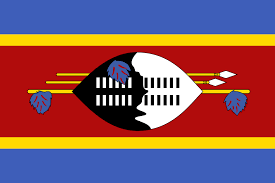
Swaziland, officially called Eswatini is a landlocked nation in the southern part of Africa. It shares a border with Mozambique to its northeast and South Africa to its West, South and North.
Here are 11 interesting things you should know about Eswatini.
1. No longer Swaziland
Do you often confuse Swaziland for Switzerland? Many of us are on this table, lol.
King Mswati III marked the 50th anniversary of Swazi Independence on April 19, 2018, by changing the country’s name from the Kingdom of Swaziland to the Kingdom of Eswatini. One of the aims of giving the country a new name was to prevent the confusion with its similar name, Switzerland. Eswatini in Swazi language means the “land of the Swazis”.
2. One of the smallest country in Africa
According to Africa-facts, this landlocked nation, Eswatini is the 7th smallest country in Africa by size with a land mass of about 17,364 km2.
3. Has two official capitals
Swaziland is one of the few nations across the globe that has two official capitals, Mbabane and Lobamba. The former operates as the country’s administrative capital while the latter is where the legislative Assembly of Swaziland is situated.
While Mbabane houses 14 foreign embassies and consulates, Lobamba is the seat of the traditional and spiritual rulers of the nation.
4. The only absolute monarchy in Africa
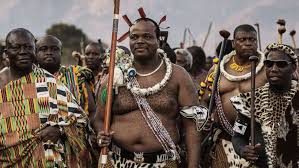
Swaziland is presently the only nation in Africa that operates an absolute monarchy.
Eswatini operates an absolute monarch system of government with Swazi law, customs and constitutional provision. The King (Mswati III) is the functional head of state and has the sweeping powers over almost every aspect of the Swazi life, including making the final decisions, appointing political leaders, among other functions.
According to the traditions of the land, the king rules together with his mother or a ritual substitute. While the king is seen as the administrative head of state, his mother or ritual substitute is viewed as the national and spiritual head of state
5. Currency rate is same with South African Rand
Swaziland currency, Lilangeni is held at the same fixed rate as that of South African Rand. Businesses in South Africa and Eswatini accept both currencies as payment.
6. First wife of the King is the Ritual wife
By tradition, the king is required to marry one wife from every traditional clan to seal his relationship with them and Mswati III currently has 14 wives. He can also pick a new wife every year during the traditional reed festival.
The first wife of the king, known as Inkhosikati (Queen) – LaMatsebula (The Great Wife) is the ritual wife who must belong to Matsebula clan. She holds special functions in traditional festivals and rituals. She must come from a good family and be of good behaviour and character. However, her son can never become a king, according to tradition.
7. Carries out annual fertility festival
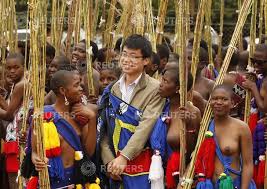
Every year in Eswatini (Swaziland), the people of Swazi celebrate a cultural festival called “Umhlanga or Reed dance” which promotes virginity and chastity and attracts over 40,000 young women all over the country. On the 8th day of the festival which is the final day, the maidens dance bare-chested with colourful attires at the royal village. Tradition requires the king to choose one of the young women as a wife, although in recent times the Reed Dance festival has been more about maintaining a cultural heritage.
8. Has the highest level of HIV/AIDS rate in the world
According to Statista, Eswatini has the highest rate of HIV/AIDS in the world with a total of 27.3% of its population affected.
9. Has one of the oldest native reserves in the world
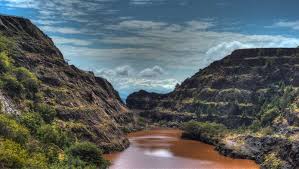
Eswatini is home to one of the world’s oldest reserves. This was established using radiocarbon dating which produced the age of its mining activities as 41,000 to 43,000 years. Ngwenya Mine is a UNESCO site located at the North-West border of the country. The haematite ore deposit was used in the middle stone era to extract red ochre used in rituals and cosmetics. In recent times, the deposit is mined for iron smelting, as well as iron ore export.
10. Swaziland has housed people for at least 27,000 years ago
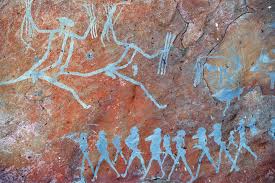
Photo Source: Africa-counter.com
People have probably stomped and lived in Swaziland for a long time. Prehistoric rock paintings are found across the country dating back to 25,000 B.C. Other paintings on the rock can also be spotted throughout Swaziland which date back to the 1800s.
11. Home to numerous animals and birds
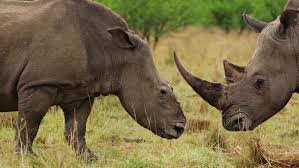
Swaziland accommodates diverse species of animals and birds. The country houses 107 species of mammals and about 507 bird species, some of which are endangered. These animals can be found abundantly in protected areas like four frontier conservation areas, wildlife parks, and seven nature reserves.

 G-Exotic World
I loved visiting Eswatini. I would love to go back again soon. Thanks for posting this!
LikeLiked by 1 person
Thanks for taking the time to read this post😘
LikeLike
Great post 😁
LikeLiked by 1 person
Thanks dear😊
LikeLike